Marrakech and the Sahara, Morocco: what a package should include
The honest picture
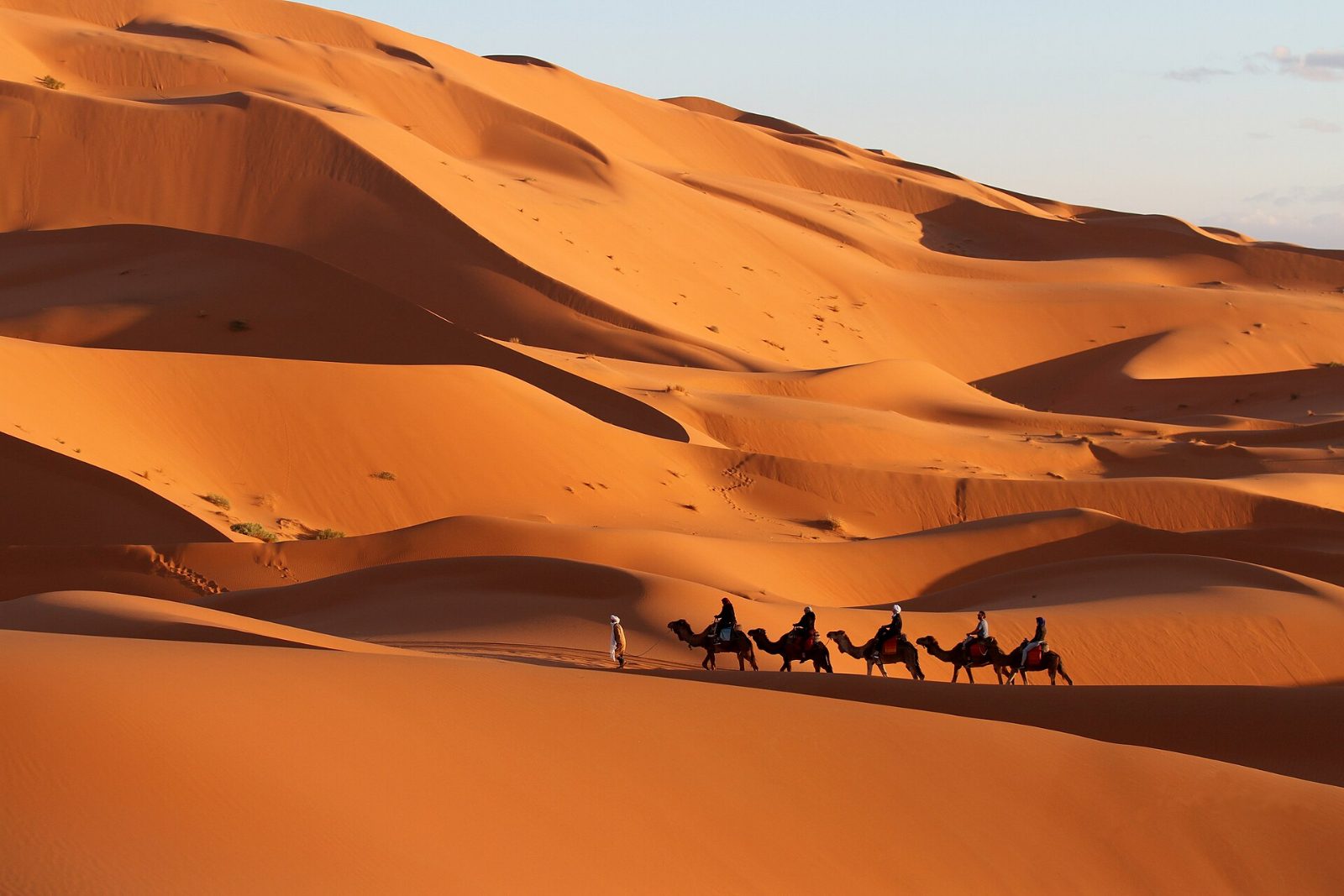
The Marrakech-to-Sahara circuit is Morocco's signature package: a red-walled imperial city, the High Atlas crossed by the Tizi n'Tichka pass, the mud-brick ksar of Aït Benhaddou, the Dadès and Todra gorges, and finally the Erg Chebbi dunes at Merzouga near the Algerian border, where a night in a desert camp is the emotional peak of the trip. Most loops then continue north to Fès, or return to Marrakech by the same road.
It is packaged because the distances are long, the roads are slow and the alternative is a hire car on mountain switchbacks. Marrakech to Merzouga is a full two days by road with the stops that make the journey worthwhile; the single-day 'express' versions exist and are ten hours in a minibus. An operator supplies the driver, the overnight stops and the camel-and-camp night in one bundle, and for a first visit to North Africa that is genuinely useful.
The honest picture: this is a driving holiday with a desert finale, not a desert holiday. Expect four to seven hours in a vehicle on most days of the circuit, hairpin roads, and a sequence of shopping stops that are part of the local economy whether or not they appear on the printed itinerary. Marrakech's medina is loud, crowded and full of people hoping to guide, sell or photograph you for money; Fès is quieter but more disorienting. Merzouga itself is a strip of hotels beside the dunes, and the camps are close to one another and to the village even when the marketing suggests otherwise.
Weather sets the season. Spring and autumn are the comfortable windows; midsummer heat in the south is dangerous for anyone unused to it, and winter nights in the dunes fall close to freezing. During Ramadan, restaurants and shops in smaller towns keep short hours and drivers are fasting, which changes the rhythm of the day without stopping the tour.
When to go
March to May and September to November. The desert is dangerously hot in July and August and cold at night in December and January.
What a typical package looks like
7 to 10 day circuits from Marrakech: High Atlas, Ait Benhaddou, Dades or Todra gorges, Merzouga dunes with a night in a desert camp, then Fes. Private-driver and small-group formats both common.
| Length | Shape |
|---|---|
| 3 days / 2 nights, Marrakech to Merzouga to Fès | The backbone of the region's tour trade: over the Atlas to the Dadès valley, then Todra gorge and the dunes for the camp night, then a long third day to Fès. Sold by hundreds of Marrakech agencies as shared minibus tours and by private-driver companies; suits people on a tight schedule who accept two very long driving days. |
| 7 to 8 days, the classic loop | Marrakech, Aït Benhaddou, Dadès or Todra, Merzouga, then Fès and back to Marrakech or Casablanca via Meknès and Rabat. This is the standard small-group package from international operators; suits first-time visitors who want the imperial cities and the desert in one trip. |
| 10 to 12 days, the grand tour | Adds Essaouira on the coast and Chefchaouen in the Rif, sometimes Volubilis and the Middle Atlas, with more time in the medinas. Sold by both group operators and private-driver specialists; suits second visits or anyone who dislikes leaving before a place has been absorbed. |
| 4 to 5 days, Marrakech and the Atlas | Marrakech with day trips to the Ourika valley or the Imlil trailheads, sometimes a night in a mountain guesthouse, no desert. Common as a city-break add-on from Europe; suits short trips and anyone who finds the desert circuit too much driving. |
What the price includes, and where money leaks
The headline price on a Moroccan circuit normally includes the vehicle and driver, accommodation with breakfast, the desert camp night with dinner and breakfast, and the camel trek to the camp. It usually excludes lunches, most dinners outside the desert, entry fees to sites such as Aït Benhaddou and the kasbahs, the licensed city guides in Marrakech and Fès, and tips. 'Private tour' often means a private driver rather than a private guide; a driver may not be permitted to guide you inside the monuments and medinas, where a separate licensed guide is hired for a half day.
Leaks are mostly small and many. Restaurant lunches on the road are chosen by the driver and priced for tourists; site entries and the hammam and cooking-class optionals add up; and the shopping stops (argan cooperatives, carpet houses, pottery, fossil workshops on the Erfoud road) are there because they pay commission. Camp standard is the biggest single variable: a luxury camp with en-suite tents and a proper bed costs several times the standard camp with shared toilets, and both are sold as 'a night under the stars'. Single supplements apply on every hotel night and in the camp.
Compare quotes by asking for the driving hours per day, the names of the towns for each overnight, the camp category, whether the Fès and Marrakech medina tours are with a licensed guide, and how many 'visits to local artisans' are scheduled. A cheap quote that stays in Ouarzazate rather than the Dadès valley, or in a hotel in Merzouga village rather than a camp, is not the same product.
Getting there
Marrakech Menara airport is the usual start, with direct flights from most of western Europe; Casablanca is the main long-haul hub with a train to Marrakech in under three hours, and Fès has its own airport, which allows open-jaw itineraries that finish there rather than driving back. Within the country the circuit is entirely by road; there is no rail line south of Marrakech.
Packages almost always include an airport transfer to the riad or hotel, and it matters more here than elsewhere because taxis at Marrakech airport are a well-known source of overcharging. Riads inside the medina cannot be reached by car; the transfer ends at the nearest gate or square and a porter walks the luggage the last few hundred metres, which is normal and is sometimes tipped separately.
Where packages put you
In Marrakech and Fès, packages use riads, traditional courtyard houses in the medina converted into small guesthouses, or larger hotels outside the walls in Guéliz and the Hivernage district. Riads are the atmospheric choice and vary from a few simple rooms to boutique properties with pools; they involve narrow stairs, no lifts, and a walk from the car. Hotels outside the walls are easier for luggage and coaches, which is why bigger group tours tend to use them, at the cost of feeling nowhere in particular.
On the road, overnights are in kasbah-style hotels in the Dadès or Todra area, sometimes a guesthouse in Aït Benhaddou or Skoura, and then the desert camp. The camps range from rows of standard nomad tents with shared washing facilities to walled compounds with en-suite tents, real beds and electricity, and the price gap is large. Both are pitched a camel ride from the village, and camps that are genuinely far from any road exist mainly at the Erg Chigaga dunes near M'Hamid, which is a different and more remote circuit.
Check these before paying a deposit
- Desert camp standard. 'Luxury camp' and 'traditional camp' can be a hundred metres apart and differ hugely in comfort; ask for the camp name.
- Driving hours per day. Marrakech to Merzouga is a two-day journey; one-day versions are 10 hours in a van.
- Riad locations in Marrakech and Fes medinas: inside the walls is atmospheric but cars stop at the gate and luggage is carried.
- Shopping stops: carpet, argan and pottery 'cooperatives' pay commission to drivers. Ask how many are on the route.
Good for
First trip to North Africa Photographers Couples
Skip it if
You get carsick easily; the mountain and gorge roads are winding and long.
What to ask the operator
Ask which camp by name and category, whether the camel ride is included both ways (some camps use 4x4 transfers back in the morning), the maximum passengers per vehicle and whether it has working air conditioning, the exact driving hours on each day, and whether medina tours use a guide holding an official licence. Ask how many shopping stops are planned and confirm you can decline them without friction. If you are travelling during Ramadan, ask what lunch arrangements the operator makes on the road.
Morocco licenses tourist guides, and only licensed guides may lead groups at monuments and through the medinas; a driver-guide on a circuit is typically a driver with good English rather than a licensed guide, and reputable operators are clear about that distinction. Group size changes the vehicle and the pace: a shared minibus of sixteen makes fewer photo stops and longer restaurant halts than a private car, and large coach groups from Europe stay in hotels outside the medinas because the coach cannot get closer.
Mistakes people make here
- Taking the one-day Marrakech to Merzouga run and spending the desert night exhausted.
- Booking a 'luxury camp' from a photograph without asking for the camp's name.
- Visiting the dunes in July or August and underestimating the heat.
- Assuming the private driver is also a licensed guide for the medinas.
- Carrying no cash for entry fees, lunches and tips on the road.
- Booking a riad for a group with heavy luggage or limited mobility.
- Treating Fès as a half-day stop; the medina alone needs a full day with a guide.
Where to compare packages for Morocco
For multi-day packages, start with a marketplace to see the field, then check the operator's own site for price and terms. For day tours inside a trip you have planned yourself, use an activity marketplace.
| Use | Where | Why |
|---|---|---|
| Multi-day packages | TourRadar, G Adventures, Intrepid Travel | Widest catalogue first, then two operators that run their own trips. |
| Day tours and tickets | Viator, GetYourGuide | Fill free days; check the free-cancellation window on each listing. |
Frequently asked questions
How many days do I need for Marrakech and the Sahara?
A minimum of three days for the Merzouga camp alone, with two of them largely on the road; seven to eight days lets the loop include Fès without the pace becoming punishing. Ten days adds the coast or the north comfortably.
Is the desert camp night worth it?
Published traveller reports consistently rank the sunset camel ride and the night sky as the highlight of the circuit; the sleeping is basic at the standard camps and cold in winter. If comfort matters, a higher-category camp or a hotel at the edge of the dunes with a sunset camel ride is the compromise.
Do I need a guide in the medinas?
It is not compulsory, but Fès in particular is a maze and a licensed guide for a half day is the practical way to see it. Unlicensed 'guides' who approach in the street are best declined politely, and a good operator will have a licensed one arranged.
Merzouga or Zagora?
Merzouga has the big Erg Chebbi dunes that appear in the photographs; Zagora is closer to Marrakech and its two-day tours reach much smaller dunes. Two-day 'Sahara' tours from Marrakech are usually Zagora, and the difference is rarely spelled out in the sales copy.
Is Morocco safe for group and solo travellers?
Morocco is a well-established tourism destination and the tour circuit is routine; the main irritants are persistent selling and occasional overcharging rather than danger. Standard precautions apply in the medinas at night, and women travelling alone report more attention than in Europe but rarely anything beyond that.
What is the best time of year?
March to May and late September to November for the desert and the mountains together. Winter is fine for the cities and cold in the dunes at night; summer is best avoided in the south, where daytime temperatures are extreme.
From operator itineraries, official tourism and park authorities, and published traveller reports. Nobody on the team is claiming a trip they did not take. Prices are deliberately left out because they change weekly; check the operator page on the day.